
Nissan Certified Pre Owned Financing: Best Rates in 2026
Nissan Certified Pre-Owned financing typically prices 3 to 7 percentage points below standard used-car loans and pairs the loan with a 7-year or 100,000-mile limited warranty. That combination matters because a slightly higher vehicle price can still produce a manageable budget when the loan carries a lower APR and the vehicle includes meaningful protection from the start.
You’re probably looking at two similar Nissans, comparing the payment on your phone while a salesperson waits nearby. One is used. The other has a CPO badge, a higher asking price, and manufacturer-backed coverage. The right comparison isn’t the advertised monthly payment. It’s the total amount financed, interest over the full term, warranty protection, and every fee added before you sign.
Table of Contents
- Where You Stand at the Nissan Finance Desk
- What Nissan Certified Pre Owned Financing Actually Is
- Rates, Terms, and Down Payment Expectations
- CPO Financing Versus a Standard Used Car Loan
- How to Apply and What to Bring
- Fees, Add-Ons, and Where the Deal Quietly Changes
- A Smart Buyer’s Pre-Signing Checklist
Where You Stand at the Nissan Finance Desk
Two Rogues can look nearly identical from the curb: same model year, similar trim, and close mileage. One carries an as-is price and a clean vehicle history. The other is a Nissan Certified Pre-Owned vehicle, priced higher because it passed Nissan’s certification process and includes manufacturer-backed protection.
That difference changes the loan, not just the window sticker. Nissan’s U.S. program combines a limited warranty tied to the vehicle’s original in-service date with prepaid maintenance during the first year. It also requires a detailed inspection, as described on Nissan’s Certified Pre-Owned program page.
You are comparing a warranty-backed loan product with an ordinary used-car loan. The CPO Rogue may require more money upfront, yet the certification premium can buy coverage and maintenance that reduce the risk of a large repair bill. Whether it improves the deal depends on the APR, the term, and how much of that premium gets financed.
What changes at the desk
A standard used-car loan treats the vehicle mainly as used inventory. CPO status gives the lender and dealer a documented inspection and manufacturer-backed coverage to include in the financing discussion. It does not guarantee a low rate. Your credit profile, the lender receiving the application, the vehicle price, and the term still shape the offer.
Ask the finance manager to separate these figures on the worksheet:
- Vehicle price: Confirm the selling price before trade equity, taxes, and optional products.
- Amount financed: Check whether fees, GAP coverage, service contracts, or other add-ons are rolled into the loan.
- Total of payments: Compare the full repayment amount, not only the monthly payment.
A longer term can make the CPO payment look comfortable while increasing total interest. A higher APR can erase the value of the certification coverage. A large certification premium can do the same if it is financed instead of paid upfront.
Practical rule: A CPO badge does not make an expensive loan affordable. The vehicle price, warranty value, APR, term, and contract must work together.
Before approving the deal, ask the manager to show how the payment changes with the CPO price, APR, and term adjusted separately. Those figures reveal whether you are paying for useful protection or financing a higher starting price.
What Nissan Certified Pre Owned Financing Actually Is
Think of Nissan Certified Pre-Owned financing like buying a refurbished appliance with a manufacturer service contract attached. The item has already been evaluated, the manufacturer defines the eligibility standards, and the service contract reduces some of the uncertainty that comes with buying used. The loan still carries interest, but the lender isn’t evaluating the vehicle exactly like an older, unprotected unit.
That distinction makes Nissan Certified Pre-Owned financing a warranty-tied loan product. The vehicle’s certification status, the lender’s pricing model, and the loan term combine to produce the offer on the worksheet.
Certification status comes first
Nissan’s U.S. program requires a detailed inspection and is designed to give used-vehicle shoppers added confidence. The coverage is tied to the vehicle’s original new-car in-service date, so the warranty clock doesn’t necessarily begin on the day you buy it. Confirm the in-service date and the warranty registration before assuming the full coverage period remains available.
Nissan Canada shows how the brand uses eligibility and coverage tiers in another market. Its Certified Pre-Owned vehicles are limited to select Nissan models up to 6 years old with less than 120,000 km, while the certified powertrain warranty lasts 72 months or 120,000 km from the original in-service date and covers more than 600 components. Nissan Canada also offers a Certified Select tier with 6 months or 10,000 km of coverage, as explained on its Canadian Certified Pre-Owned program page. Those Canadian thresholds aren’t U.S. eligibility rules, but they illustrate why age, mileage, inspection, and coverage must be checked independently.
The lender sets the rate
Nissan Motor Acceptance Company may provide manufacturer-supported offers when a vehicle and buyer qualify. A bank or credit union may price the same certified vehicle differently. The dealer’s first offer isn’t automatically your only offer, so bring an outside pre-approval or compare the contract with a credit union quote.
The term controls the cost
A shorter term generally raises the payment while reducing the time interest accrues. A longer term lowers the payment but can keep you financially tied to the vehicle after its market value has fallen. Use the dealer’s calculator, your bank’s calculator, or a spreadsheet to compare total repayment before you focus on whether the payment fits your current month.
Warranty coverage supports the case for CPO financing, but it doesn’t erase underwriting rules. Your credit profile, debt obligations, down payment, vehicle price, and selected term still determine the final contract.
Rates, Terms, and Down Payment Expectations
A dealer quotes you a $28,000 certified Nissan at a low promotional APR, then offers a longer term to keep the payment comfortable. That quote still needs pressure-testing. CPO financing is a warranty-backed loan product, so compare the APR, amount financed, loan length, and certification premium together.
Independent rate comparison research places some CPO rates near 4.9% to 7.9%, compared with standard used-car rates around 11% to 14%. Your approved rate can differ based on credit profile, lender, vehicle, and promotion. Certified vehicles may also cost about 10% to 20% more than comparable non-certified vehicles. A lower APR does not automatically make the CPO vehicle cheaper overall.
Rate is only one part of the quote
Use the same vehicle price, down payment, and term when comparing offers. For a simple illustration, assume $28,000 financed with no taxes, fees, trade equity, or down payment:
| Loan example | Monthly payment | Total interest |
|---|---|---|
| 60 months at 6.9% APR | About $553 | About $5,200 |
| 72 months at 6.9% APR | About $478 | About $6,400 |
These figures illustrate the effect of term length, not a Nissan quote. Results vary with the approved APR, taxes, fees, down payment, and financed add-ons. Enter your exact numbers into a trusted loan calculator before signing.
The certification premium matters because it becomes part of the balance if you finance it. Ask the finance manager to show the non-certified vehicle price, CPO price, APR, amount financed, total of payments, and warranty terms on separate lines. Then decide whether the interest savings and warranty protection justify borrowing more.
Term and cash down
A 60-month term usually gives you a better balance between payment size and total interest than stretching the loan farther. A 72-month term can reduce the monthly payment, but interest accumulates longer and the vehicle may lose value faster than you reduce the balance.
A larger down payment lowers the amount financed and may strengthen the application. It also reduces the risk of owing more than the Nissan is worth. Ask exactly how your cash down and trade equity change the APR, amount financed, and loan-to-value calculation.
The payment you can afford today isn’t the same as the loan you can afford in total.
Remove optional products from the worksheet first. Compare the CPO Nissan with a non-certified alternative, then add only the coverage you deliberately choose. This shows whether the lower APR reduces total cost or merely makes a higher-priced, warranty-backed vehicle appear easier to buy.
CPO Financing Versus a Standard Used Car Loan
Compare the same Nissan, same borrower, same down payment, and same loan term. If you change all four variables, you won’t know whether the result comes from certification or from a different financing structure.
The strongest CPO argument is the combination of APR and protection. The supplied research describes CPO financing as often materially cheaper than standard used-car financing and places the typical difference at roughly 3 to 7 percentage points in some franchise-financing comparisons. Nissan’s U.S. program adds a factory-backed limited warranty and prepaid maintenance, while a regular used vehicle may have only remaining original coverage, no manufacturer-backed coverage, or a separate aftermarket contract. The exact warranty terms belong in your paperwork, not just in the salesperson’s explanation.
| Feature | Nissan CPO Loan | Standard Used Loan |
|---|---|---|
| APR range | Often lower when the buyer and vehicle qualify | Often higher, especially outside promotional tiers |
| Warranty | Nissan factory-backed limited coverage, subject to original in-service date and terms | Remaining factory coverage, no coverage, or separately purchased protection |
| Eligibility age | Must meet Nissan program requirements | Broad lender and dealer eligibility rules |
| Inspection depth | Detailed Nissan certification inspection | Dealer inspection may vary |
| Total interest | Can be lower when the APR savings exceed the CPO price premium | Can be higher when the vehicle price is lower but the rate is materially higher |
Put the premium under pressure
Suppose the CPO SUV costs more than the non-certified version. Ask the dealer to show both loans side by side, using identical cash down and term. Then calculate the difference in total payments. If the CPO loan’s interest savings don’t offset the certification premium, the warranty still may justify the purchase, but you should call it what it is: a protection decision, not a guaranteed financing bargain.
Don’t assign a dollar value to a hypothetical transmission failure unless you have an actual repair estimate and confirmed warranty eligibility. Instead, verify whether the component is covered, whether exclusions apply, and whether the warranty is transferable. Nissan’s published program terms are the proper reference for coverage, not a verbal promise made during negotiation.
The better choice depends on how much uncertainty you’re willing to carry. A cheaper non-certified vehicle with a higher rate can cost more over time, while a CPO vehicle can justify its price through lower financing cost and manufacturer-backed protection. Run both total-cost scenarios before choosing.
How to Apply and What to Bring
A dealership quote can look affordable until the APR, loan term, certification premium, and optional products are separated. Apply before visiting the lot, then compare the same VIN through Nissan’s finance desk, a bank, or a credit union. Pre-qualification sets a useful ceiling, but it does not guarantee the final APR.
Follow the application path
- Check pre-qualification: Use available Nissan finance tools or a soft-pull option such as Capital One Auto Navigator to estimate possible financing. Treat the result as a starting point, not approval.
- Get a dealership comparison: Ask the Nissan Finance Center to submit your application to participating lenders. Request each approved APR, term, amount financed, monthly payment, and total of payments.
- Choose the vehicle: Confirm that the specific VIN carries Nissan CPO certification. “Eligible” or “inspected” does not mean certified.
- Review the hard-pull contract: Check the APR, term, payment, total payments, selling price, fees, taxes, and optional products before signing. A lower payment can mean a longer loan.
- Decide on protection products: Review GAP insurance and any extended service contract separately. Remove duplicate coverage from the payment presentation unless you deliberately choose it.
Nissan’s U.S. CPO warranty lasts 7 years or 100,000 miles from the original new-car in-service date, whichever comes first. Ask the dealer to provide that date in writing. The included maintenance benefit lasts one year or the first 15,000 miles in the first year of ownership, whichever comes first, under Nissan’s published CPO terms. Confirm how both benefits will appear in the paperwork, and check that the VIN qualifies.
Bring a complete file
- Government ID: Bring a current driver’s license or another accepted form of identification.
- Proof of insurance: Have active coverage details ready for the vehicle you plan to finance.
- Income records: Bring two recent pay stubs, plus a W-2 or 1099 where applicable.
- Address verification: A recent utility bill can support residence verification.
- Trade documents: Bring the title or payoff letter if you are trading in a vehicle.
If you are shopping in Jackson Heights or elsewhere in Queens, completing an online application can reduce dealership time. Heights Nissan offers online financing tools, Capital One pre-qualification, payment calculations, and trade-in valuation resources. Use those tools to organize your figures before discussing the final CPO loan.
Fees, Add-Ons, and Where the Deal Quietly Changes
A CPO loan is a warranty-backed loan product, not merely a used-car payment plan. The advertised APR applies to the financing terms, while the amount financed can expand through the vehicle price, documentation fee, taxes, registration, GAP insurance, service contracts, and appearance packages. Judge the quote by both monthly payment and total repayment.
The certification premium may already be included in the asking price. Ask the salesperson to show the selling price before and after certification, then verify what warranty coverage that premium supports. A higher price can raise interest charges across the full term, even when the APR looks competitive.
Read every line
Review these items separately:
- Certification amount: Confirm whether the CPO cost is already included in the selling price, and request the supporting warranty documentation.
- Documentation fee: Include the dealer fee in the out-the-door price before comparing offers.
- Title and registration: Check the government charges against your local requirements.
- GAP insurance: Compare the dealer’s price and coverage with outside options, based on your loan-to-value position.
- Extended service contracts: Check for overlap with Nissan’s included CPO coverage before paying for another contract.
- Tire, wheel, paint, and protection products: Remove each optional product first. Add back only what you can explain and want.
A separate August 2026 settlement announced by the FTC and Connecticut involved $4 million and alleged deceptive fees, including allegations that consumers were charged to “certify” vehicles already advertised as certified pre-owned and that add-ons were inserted into financing agreements without informed consent. Treat that as a reason to demand clear paperwork, not as a reason to accept a vague payment quote. The buyer’s order should show the vehicle price, every fee, each optional product, the down payment, and the resulting amount financed.
Ask for the out-the-door price and the buyer’s order before you discuss monthly payment.
Your contract should identify which coverage comes from Nissan, which products are optional, and which fees you can decline. If the finance manager will not remove an unwanted product or explain its cancellation terms, pause the deal and request another quote. Judge the offer by the complete loan cost, not the payment displayed on the desk screen.
A Smart Buyer’s Pre-Signing Checklist
Use this checklist while the finance manager is reviewing the contract. The goal isn’t to make the paperwork difficult. It’s to ensure the payment reflects the vehicle you chose, not products or fees you didn’t knowingly authorize.
- APR versus term: Compare the annual percentage rate and loan length together. A lower payment from a longer term can still create a higher total repayment.
- Out-the-door price: Confirm that the final price includes the vehicle, taxes, title, registration, dealer fees, and every add-on.
- Down payment and trade-in: Verify the cash down, trade value, payoff balance, and resulting equity. Negative equity should never disappear into the new loan.
- Loan term: Price the deal at a shorter term before accepting a longer one. Use the Nissan payment calculator and compare total payments.
- Fees and add-ons: Identify GAP, service contracts, tire-and-wheel coverage, paint protection, and other extras. Ask for cancellation language in writing.
- Pre-approval: Bring a competing lender offer. Use it to test whether the dealership can improve the APR or reduce the vehicle price.
- Warranty start date: Request the original in-service date, confirm the 7-year or 100,000-mile coverage limit, and make sure the VIN and warranty registration match.
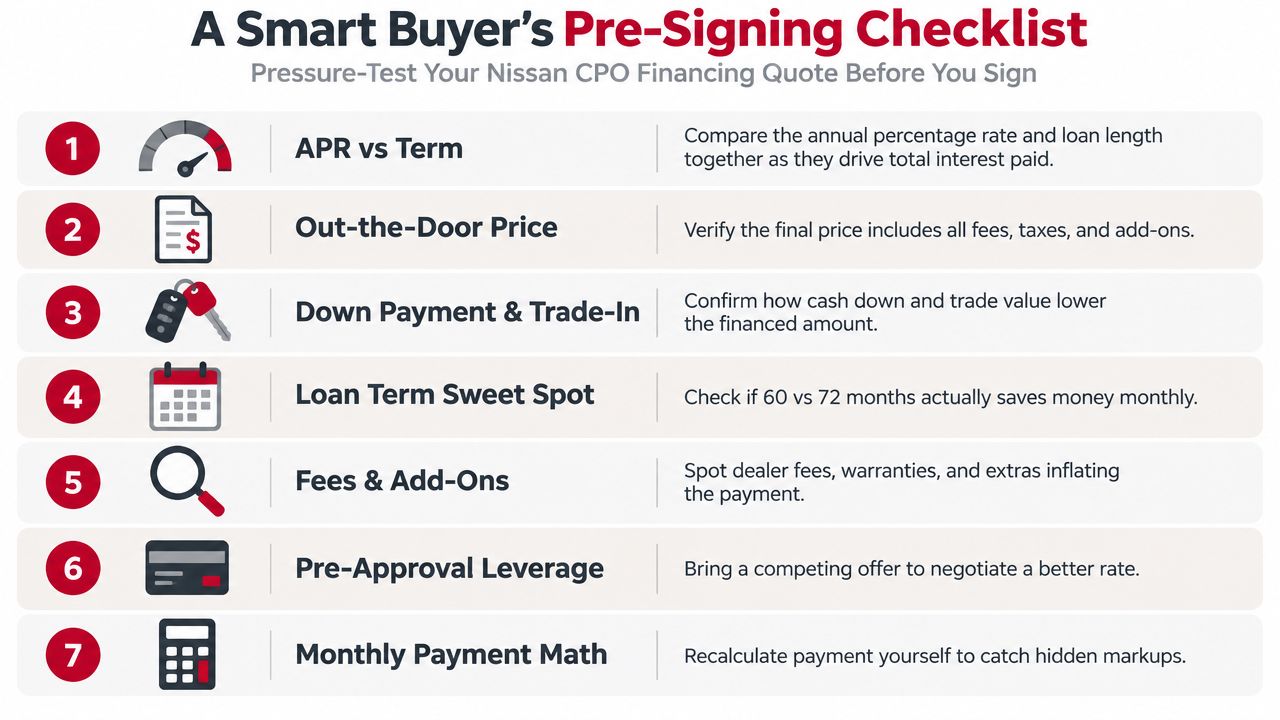
Recalculate the payment yourself using the exact amount financed, APR, and term shown on the contract. Then compare the result with the finance manager’s figure. A small difference can signal a fee, product, or amount-financed change that wasn’t obvious in the presentation.
If the finance manager can’t answer each item in writing, don’t sign. Walk out, re-price the same vehicle through another Nissan store or credit union, and return only when the complete cost is clear.
Heights Nissan can help you compare Nissan Certified Pre-Owned inventory, financing options, payment calculations, and trade-in values before you finalize a deal. Review the numbers online, then visit Heights Nissan in Jackson Heights to examine the vehicle, verify its warranty paperwork, and request an itemized quote.
0 comment(s) so far on Nissan Certified Pre Owned Financing: Best Rates in 2026