
Nissan Dealer Services Explained What to Expect
You might be sitting in Jackson Heights with a shortlist of Nissan models in one browser tab, a financing calculator in another, and a service question you haven’t figured out yet. That mix is normal, because buying a car isn’t just a showroom decision, it’s a service decision too. Nissan dealer services cover the whole ownership path, from the first test drive to the day you need maintenance, parts, or help sorting out what kind of repair belongs at the dealership.
A good dealer experience should make the next step obvious. If you’re comparing a new Rogue, a Certified Pre-Owned Altima, or a LEAF for your daily commute, the dealership is where those choices connect to finance, inspection, parts, and long-term care. The point isn’t to memorize every department, it’s to understand how the pieces fit together so you can ask the right question at the right time.
That’s especially useful in Queens, where time matters and every trip you don’t have to make saves real energy. A local Nissan store can help you browse, book a test drive, estimate payments, value a trade, and line up service without forcing you to repeat yourself at every counter. When the process is clear, you spend less time guessing and more time driving what fits your life.
Table of Contents
- Introduction to Nissan Dealer Services in Queens
- How Nissan Dealer Services Work Together
- Finding Your Next Nissan From New to Certified Pre-Owned
- Financing Trade In and Offers Made Simple
- Service Center Express Service and Genuine Parts Support
- Electric Vehicle Resources and Ownership Guidance
- Getting the Most From Your Dealership Visit
Introduction to Nissan Dealer Services in Queens
A first-time buyer may see the dealership as the place where the paperwork ends and the keys change hands. In reality, it works more like a home base for ownership. You can begin with discovery, move into financing, and later return for maintenance, parts, or warranty questions, all in one place.
That matters because car ownership rarely follows a straight line. One week you are comparing models, and the next you are trying to sort out whether a concern belongs with the dealer, Nissan corporate, or an independent repair shop. Nissan’s own help pages show that a dealer can handle vehicle questions, service-policy issues, parts, accessories, and help determine whether a vehicle needs service, while separate contact paths cover retail, lease, app, EV, and reimbursement topics (Nissan contact and support channels).
The dealership is more than a showroom
The dealership works like a neighborhood clinic with different specialists. Sales helps you choose a vehicle, finance helps structure the purchase, service takes care of the car after the sale, and parts keeps the right components available when something needs replacement. That setup is one reason dealer service feels different from a generic repair stop, especially for newer Nissan models that rely on factory procedures and diagnostics.
For a Queens buyer, the benefit is less back-and-forth. If you are comparing a new SUV and a used commuter car, the same store can usually show inventory, explain payment options, and talk through what future maintenance may look like. That helps when you are balancing weekday driving, family errands, and the practical question of how much time service visits will take.
Practical rule: if your question touches the vehicle’s history, warranty, or factory service process, the dealer is usually the first place to ask.
Heights Nissan at 74-15 Northern Boulevard is one local example of that full-service model. The store is not only about inventory on the lot, it also includes the support systems that make ownership less confusing after the sale. Once you understand that, the rest of the process starts to make a lot more sense.
How Nissan Dealer Services Work Together
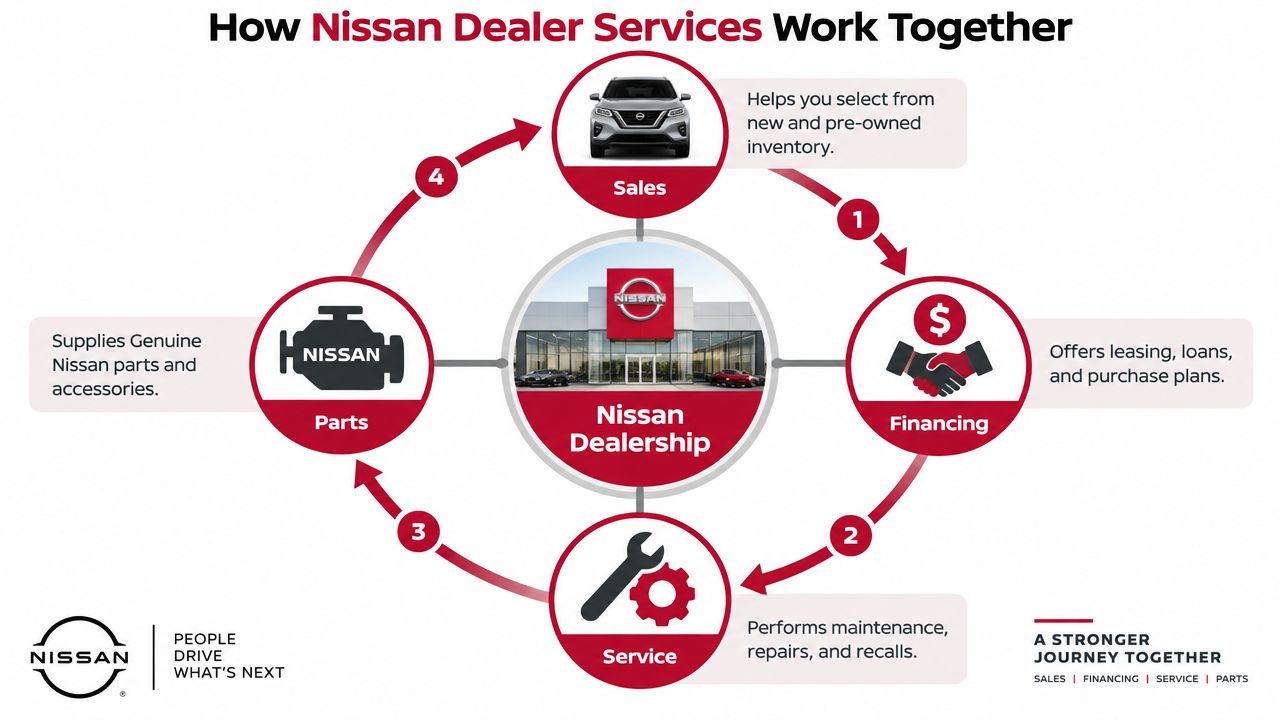
A Nissan dealership works best when you treat it like a connected system instead of four separate desks. Sales, financing, service, and parts each solve a different problem, but they’re supposed to hand off to each other smoothly. That handoff is what keeps the ownership experience from feeling fragmented.
The four departments that carry you from purchase to upkeep
Sales starts the journey by helping you choose a vehicle that fits your budget and driving habits. Financing then turns that choice into a payment structure, whether you’re leasing, buying, or comparing options. Service keeps the vehicle on the road after delivery, and parts supplies the components and accessories needed for maintenance and repairs.
The logic is simple. If sales helps you get the right car, finance helps you bring it home, service helps you protect it, and parts helps keep repairs consistent with factory standards. Nissan’s service network is built around a formal technician development system called SCOPE, with required training across Electrical, Engine, Chassis, and Driveline specialties, and the highest tier, Master Technician, requiring all four plus New Model Training (ASE/Nissan SCOPE).
That training structure matters because it changes the kind of care your vehicle gets. Nissan dealer service isn’t just routine maintenance, it’s standardized factory training, diagnostic specialization, and continuing education for modern vehicles, including hybrids and electric models. Nissan’s service messaging also emphasizes certified technicians, genuine parts, and advanced diagnostics, which is a very different model from a general repair bay.
Dealer support, corporate help, and independent shops each have a role
The confusing part for many owners is knowing who to contact first. The dealership can help with the vehicle itself, but Nissan corporate channels may be the better route for app, connectivity, or reimbursement questions. Independent shops can still be useful for general repairs, especially if you’re outside the warranty window or handling work that doesn’t require factory-specific procedures.
Use the dealer when the issue involves model-specific diagnostics, warranty questions, genuine parts, or service records that matter later. Use corporate when your question is about ownership programs, brand-level policies, or support pathways that aren’t tied to a physical repair visit. Use an independent shop when the work is straightforward and you’re comfortable with a non-factory setting.
The big advantage of the dealer model is that the departments can talk to each other. If a salesperson explains a feature, the service team can later maintain it, and the parts counter can source the right component if something needs replacement. That continuity is what makes the dealership useful long after the sale.
Finding Your Next Nissan From New to Certified Pre-Owned
Most shoppers start with a model, but the smarter way to shop is to start with the job the car has to do. If you need space, maybe you look at Rogue, Pathfinder, Armada, or Murano. If you want a sedan or city-friendly commuter, Altima, Sentra, or Versa might be the better fit. If you’re looking at EV or plug-in ownership, LEAF and Rogue PHEV deserve attention too.
Start with the new lineup, then narrow by need
A good shopping process begins with a test drive, because features on a screen never tell the whole story. The vehicle finder, build-and-price tools, and model research pages help you compare trim details before you step onto the lot, which saves time and makes the visit more focused. That’s especially helpful when you’re deciding between a roomy SUV and a smaller car that’s easier to park in the neighborhood.
The practical order usually looks like this:
- Identify the body style first. SUV, sedan, pickup, EV, or plug-in hybrid each solves a different daily problem.
- Compare trims second. Features like driver assistance, interior materials, and connectivity can shift a model from “close” to “perfect.”
- Book the test drive last. Once you’ve narrowed the field, driving the car makes the decision real.
Shoppers who want a fresh start can begin with the full new Nissan lineup, then move toward pre-owned inventory if the budget or timing makes more sense. That’s where used vehicles under consideration can become meaningful, especially if the goal is to maximize value without giving up the Nissan badge or dealer support.
Why Certified Pre-Owned changes the trust equation
Nissan Certified Pre-Owned is different from ordinary used inventory because a Nissan-trained technician must inspect the vehicle before it can be certified. The program ties dealer service directly to quality assurance, and Nissan’s own CPO page says the process is built around a rigorous inspection by a Nissan-trained technician (Nissan Certified Pre-Owned program). That makes the service department a gatekeeper for resale value, warranty coverage, and customer trust.
For buyers, the appeal is simple. You get a used vehicle that has been checked through a factory-backed process instead of relying only on a seller’s word. Nissan’s CPO ecosystem also reinforces genuine parts usage and dealer-maintained service capability, which helps explain why dealer service remains central even when you’re shopping pre-owned.
A certified used vehicle should feel less like a gamble and more like a known quantity.
If you’re trying to decide between new, Certified Pre-Owned, and standard used, think in terms of certainty. New gives you the latest model and full factory freshness. CPO gives you inspection-backed confidence. Standard used can still make sense, but it asks you to do more homework on history, condition, and future maintenance.
Financing Trade In and Offers Made Simple
Money questions are where many shoppers freeze up, and that’s usually because the process feels split into too many pieces. The better way to approach it is to treat financing, trade-in, and specials as one budget conversation. That keeps the numbers aligned before you get too far into the buying process.
Compare the tools before you fill out forms
Dealer finance centers usually offer a few different paths, and each one serves a different purpose. A payment calculator helps you estimate monthly cost before you commit. A pre-qualification tool can give you a quick read on likely terms without the pressure of a full application. A full credit application is the step you take when you’re ready to move from exploring to buying.
Trade-in valuation works best when you want a clear starting point for your current vehicle. A KBB Instant Cash Offer can streamline that part of the conversation by giving you a market-based estimate and a more structured appraisal path. That’s useful if you’re comparing whether to keep the old car, sell it privately, or roll its value into a new Nissan.
| Tool | Best For | What You Get |
|---|---|---|
| Pre-qualification | Early budgeting | A fast sense of what financing may look like |
| Full application | Ready-to-buy shoppers | A complete financing review for purchase or lease |
| Payment calculator | Comparing vehicles | A clearer monthly estimate before you visit |
| KBB Instant Cash Offer | Trading in a current vehicle | A streamlined valuation starting point |
Specials and incentives matter here because they shape the actual affordability of the deal, not just the sticker price. When you combine an offer with a realistic payment estimate and a trade-in number, the purchase starts to look like a plan instead of a guess.
Use digital steps to shorten the in-store part
Online financing tools are useful because they reduce the number of decisions you have to make sitting in the showroom. If you know your payment range, have an estimate for your trade, and already understand the specials that apply, the visit becomes more about confirming the vehicle than doing all the math from scratch. That’s a better fit for busy Queens buyers who’d rather spend time driving than waiting.
The same logic applies if you’re comparing new, pre-owned, or service-related offers. Everything points back to the same goal, keeping the ownership cost visible before it becomes stressful. A calm finance conversation usually starts with data, not pressure.
Service Center Express Service and Genuine Parts Support
Once you own the car, the service department is the part of the dealership you’ll use most often. Nissan’s dealer service system is built around Nissan-trained certified technicians, and that matters because modern cars need accurate diagnosis as much as mechanical repair. If a warning light appears with a drivability issue, the first step is figuring out whether the cause is electrical, software-related, or purely mechanical.
Routine care and complex repairs are not the same thing
Express Service is the lane for routine maintenance, the kind of work that keeps wear from turning into bigger problems. Tire sales and installation belong here too, because tires affect safety, ride quality, and fuel use every day. For many owners, it is the easiest way to stay current without booking a long appointment.
The deeper value is in how the service team handles the rest of the work. Nissan’s parts-and-repair guidance emphasizes Genuine Nissan Parts and a published target of over 85% OE parts utilization for repairs (Nissan parts and repair playbook). That matters because OEM parts reduce fitment variability and help lower the risk of comebacks, rework, and lost time. The same material ties parts mix to repair-quality tracking, which helps a service department keep results consistent.
For owners, the practical payoff is simple. A dealer service lane can match the part, the diagnostic tool, and the technician’s training to the vehicle in front of them. That is a better fit for electrical systems, driveline concerns, hybrid components, and software-heavy repairs than a generic one-size-fits-all workflow.
Why factory diagnostics change the outcome
Nissan’s service messaging points to certified technicians, genuine parts, and advanced diagnostics as part of the brand’s service model. That combination helps service advisors move from symptoms to cause instead of guessing. If a problem is tied to a model-specific system, factory tools and procedures usually save time.
If the issue touches a sensor, module, or warranty record, the factory-trained lane is often the safer first stop.
Service is not only about fixing what is broken. It is also about preserving the vehicle’s record, keeping maintenance aligned with Nissan’s process, and making sure the next visit starts from known facts. That is the kind of support that turns a dealership into a long-term service partner, not just a place to buy tires.
Electric Vehicle Resources and Ownership Guidance
An EV buyer usually asks different questions from a gas-car shopper. With a LEAF or Rogue PHEV, the focus shifts to charging habits, battery care, and service timing, so dealer EV resources matter early in the ownership journey.
EV service feels different because the maintenance rhythm is different
The LEAF service guide shows that many checks follow a 7,500-mile schedule, while the factory-fill coolant is specified for 125,000 miles or 15 years, whichever comes first, and then every 75,000 miles thereafter. That pushes the service conversation away from frequent oil changes and toward scheduled inspections that follow the vehicle’s own rhythm (2019 LEAF service maintenance guide).
The same guide says the EV Battery Usage Report is required as a condition of battery warranty, and the 12- and 24-month inspections are performed at no cost by a Nissan LEAF certified dealer. For a first-time EV owner, that acts like a service map. It shows what the dealer handles, what the warranty expects, and which touchpoints should already be on your calendar.
What buyers compare when they’re weighing EVs against gas vehicles
Service details do not look the same in every market. Drive’s coverage shows capped-price servicing for the LEAF in some regions, along with different EV service-plan formats in Australia and the UK, which is a reminder that local guidance matters more than a generic rulebook (Drive coverage of EV servicing costs).
For shoppers comparing LEAF or Rogue PHEV ownership with a gas vehicle, the better question is simple. What maintenance happens, and when? EV ownership usually means fewer traditional wear items, but it also depends more on correct inspections, charging habits, and warranty records. A dealer helps make that easier to follow, especially when you want the factory process explained in plain language before a service visit or purchase decision.
Getting the Most From Your Dealership Visit
A good dealership visit starts before you walk in. Bring your license, know your mileage if you’re coming for service, and write down the exact questions you want answered about financing, maintenance, parts, or a specific vehicle. That small bit of prep keeps the conversation focused.
A dealership works best as your first stop for questions tied directly to the car. Service-policy concerns, parts, accessories, warning lights, and help deciding whether the vehicle needs attention all fit there. Nissan’s support paths also split retail, lease, app, EV, and reimbursement topics into different channels, which shows why it helps to send each question to the right place from the start.
A simple checklist keeps the visit organized:
- Before purchase: schedule a test drive, compare trims, and use the vehicle finder tools.
- Before financing: use the payment calculator, review current offers, and decide whether pre-qualification or a full application fits your situation.
- Before service: book online if you can, write down warning lights, and describe the symptoms in plain language.
- Before ordering parts: have the model year and trim ready so the counter can match the right component.
For a first-time buyer, this works a lot like sorting mail into the correct folders. Sales handles the shopping questions, finance handles payment options, and service handles what the car needs after the sale. EV owners and certified pre-owned shoppers may also have extra steps, so asking early saves time and avoids guesswork.
The best dealership visits feel calm because each question reaches the right department the first time. That is what turns a Nissan store into a practical ownership resource.
0 comment(s) so far on Nissan Dealer Services Explained What to Expect