

Nissan Rogue Size: Dimensions and Cargo Guide
You’re trying to judge whether one vehicle can handle two very different jobs: fit into a tight Jackson Heights parking space on Monday morning, then carry children, a stroller, groceries, and luggage on the weekend. The label “compact SUV” doesn’t answer that question. Exterior width, turning space, rear-seat room, and the shape of the cargo area matter more than a single headline measurement.
The Nissan Rogue size sits near the larger end of the compact crossover class. It’s still manageable for urban driving, but it isn’t a small hatchback with extra ride height. Its dimensions give families useful interior room, while its footprint can demand more care in narrow garages and crowded curbside spaces.
Table of Contents
- Understanding the Nissan Rogue Footprint
- Exterior Dimensions and Urban Maneuverability
- Interior Passenger Space and Comfort Metrics
- Cargo Capacity and Real-World Family Loading
- Trim Level Implications on Space and Features
- Comparing the Rogue to Compact SUV Rivals
- Quick Reference Guide for Nissan Rogue Specs
- Finding the Right Rogue at Heights Nissan
Understanding the Nissan Rogue Footprint
The Rogue has been sold since the 2008 model year, after debuting in October 2007, and Nissan has kept its basic proportions remarkably consistent across recent model years. Its mature platform measures approximately 183.0 to 184.4 inches in length, 72.4 inches in width, and about 66.5 inches in height, with a 106.5-inch wheelbase, according to the Nissan Rogue model history and dimensions overview.
That consistency matters. Nissan hasn’t repeatedly stretched the Rogue to chase a larger-vehicle role. Instead, the company has maintained a footprint that supports family seating and useful cargo space without moving the vehicle out of the compact crossover category. The result is a vehicle that feels substantial inside, yet remains more practical for city use than a midsize SUV.
Compact classification, substantial presence
The Rogue’s exterior proportions reveal its compromise. It’s compact enough for many urban garages and parking spaces, but its 72.4-inch width gives the cabin a broader feel than the word “compact” may suggest. The 106.5-inch wheelbase helps Nissan place the wheels at the outer portions of the body, creating room for passengers without requiring a dramatically longer vehicle.
The official Nissan Rogue specifications list 41.5 inches of front legroom, 38.5 inches of rear legroom, and 36.5 cubic feet of cargo volume behind the second row. Those figures point to a clear design priority: keep the vehicle easy enough to use in daily life while giving families a cabin that doesn’t feel cramped.
Practical rule: Treat the Rogue as a large compact SUV, not as a small urban runabout.
Who benefits from this footprint
The dimensions make the most sense for households that need one vehicle to cover school runs, commuting, shopping, and occasional road trips. Adults can use the rear seat without the squeezed-knee feeling found in smaller crossovers, while the cargo area remains available behind them.
The tradeoff is equally clear. Drivers in older neighborhoods with narrow garages, tight curb lanes, or difficult turnarounds should measure their actual space before buying. The Rogue’s size is a mixed blessing. It gives families better packaging, but it won’t disappear into a difficult parking environment.
Exterior Dimensions and Urban Maneuverability
In a dense neighborhood, length is only part of the problem. A vehicle can fit within a marked space and still be awkward when the entrance is narrow, the adjacent car is parked close, or a child needs to exit beside the curb.
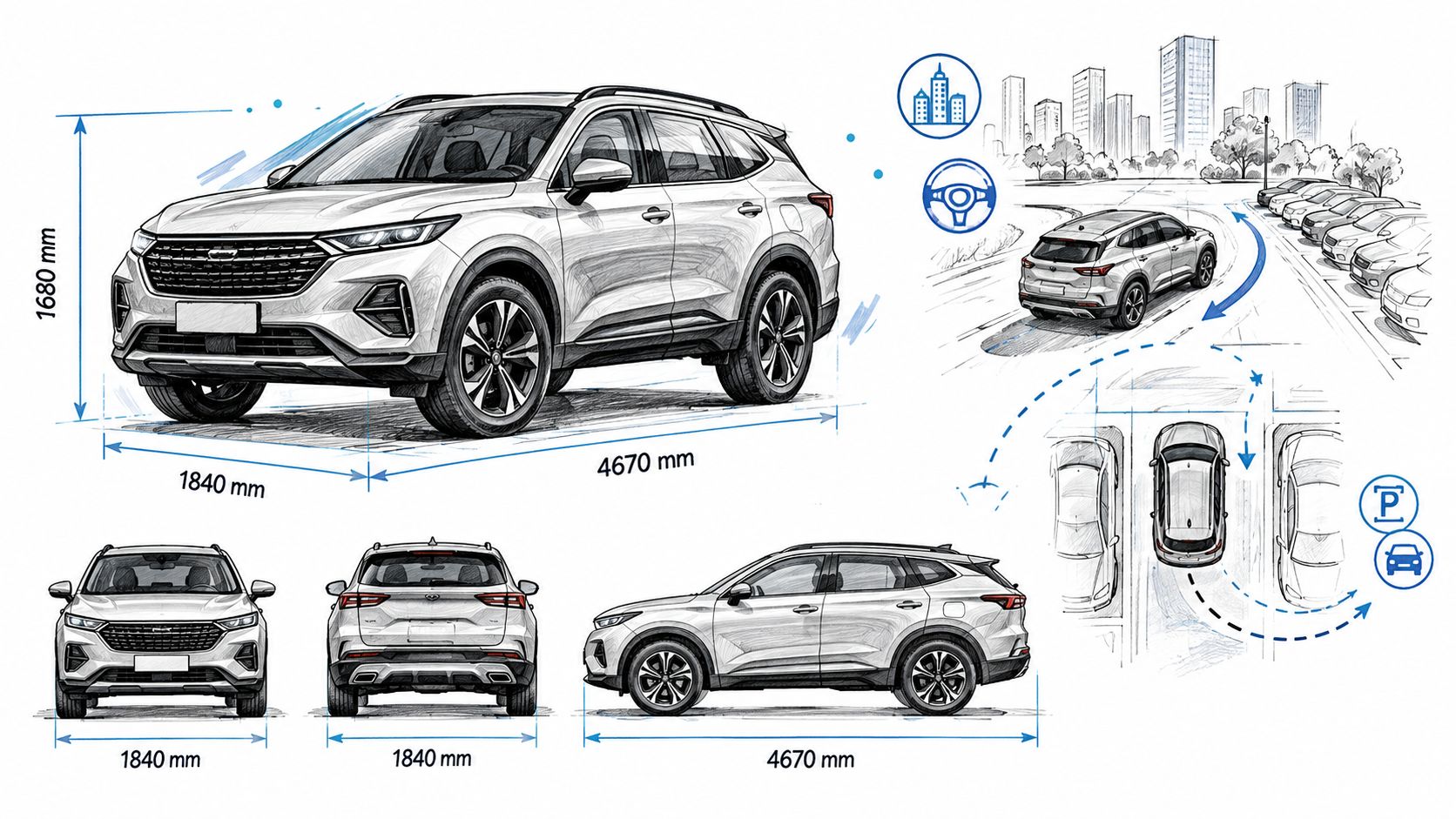
The Rogue measures 183.0 inches in length, 72.4 inches in width, and 66.5 inches in height for the current benchmark configuration, while the 2026.5 model has a 35.4-foot turning diameter, according to the Nissan Rogue press kit. Those measurements describe a vehicle that should feel predictable on open streets but requires deliberate steering in cramped city maneuvers.
What the width means at the curb
The Rogue’s width is manageable, but it’s significant when you’re loading children or groceries beside traffic. A 72.4-inch body width leaves less room for comfortable door opening than a narrow sedan in a tight curbside space. The issue becomes more noticeable when a car seat requires the rear door to open wide or when another vehicle is parked close enough to limit access.
Garage fitment deserves the same attention. Don’t measure only the opening. Check the internal width, the distance between the mirrors and walls, and the space needed to open the driver’s door. A vehicle can fit physically while still becoming frustrating if every entry requires careful alignment.
Why the turning diameter matters
The 35.4-foot turning diameter affects U-turns, narrow intersections, parking ramps, and dead-end streets. It doesn’t make the Rogue unwieldy, but it means you shouldn’t expect the same quick pivot as a smaller car. In neighborhoods with double-parked vehicles and limited sightlines, the driver may need an additional maneuver rather than completing a turn in one clean sweep.
That’s a practical distinction. A turning figure on a specification sheet tells you the vehicle’s geometry, but the street tells you whether that geometry feels comfortable. Test the Rogue on the type of road you use every day, not just around a dealership block.
Urban buying test: Drive the vehicle into your own garage or a comparable tight parking structure, then practice a three-point turn before deciding.
The Rogue’s height, around 66.5 inches, gives occupants a useful step-in position without placing it in the territory of a tall truck-based SUV. For most families, the more important urban question isn’t whether it can fit. It’s whether you can park it and load it without fighting the surrounding space.
Interior Passenger Space and Comfort Metrics
The Rogue’s strongest argument is inside the cabin. Its exterior footprint is large for the compact class, and Nissan uses that footprint to provide passenger room rather than just adding bodywork.
Front occupants receive 41.5 inches of legroom, while rear passengers receive 38.5 inches, based on the published Edmunds Rogue features and specifications. That rear measurement is the figure families should focus on. It determines whether an adult can sit behind a taller driver, whether a child seat leaves useful space for another passenger, and whether long trips feel relaxed or restrictive.
Front comfort sets the baseline
The front seats provide enough legroom for taller drivers to find a comfortable position without automatically sacrificing the rear row. That balance comes from the Rogue’s wheelbase and cabin layout, not from excessive exterior length alone.
A compact SUV often forces a choice. You either give the driver plenty of space and leave the rear passengers short on knee room, or you preserve the second row and compromise up front. The Rogue avoids the worst version of that tradeoff. It remains a compact vehicle, but its proportions support genuine family use.
The rear seat is the deciding advantage
38.5 inches of rear legroom gives the Rogue a meaningful advantage for households that regularly carry adults, older children, or rear-facing child seats. It won’t turn the vehicle into a three-row SUV, but it makes the second row more usable for daily life.
The Rogue also provides 55.9 inches of rear shoulder room, according to the same Edmunds specifications. That width helps when two adults sit beside a child seat, although three adults across any compact SUV’s rear bench will depend on body size, seat shape, and how the center position is used.
| Passenger priority | What the Rogue’s layout means |
|---|---|
| Tall driver | The front row has useful legroom without making the rear row an afterthought. |
| Rear-facing child seat | The rear legroom gives the seat more space to coexist with the front passenger. |
| Two adults in back | The rear bench offers meaningful legroom and broad shoulder room for the class. |
| Three occupants in back | Width helps, but the actual comfort depends on seat design and occupant size. |
The practical verdict is straightforward. If your family spends more time carrying people than maximizing cargo volume, the Rogue’s packaging is one of its best reasons to choose it. It feels closer to a family vehicle inside than the compact label suggests.
Cargo Capacity and Real-World Family Loading
A cargo number doesn’t tell you whether the stroller fits without removing a wheel, whether grocery bags stay upright, or whether the rear seat remains usable with a child seat installed. The Rogue’s published capacity is 36.5 cubic feet behind the second row and 74.1 cubic feet with the rear seats folded, according to the Nissan Rogue press information.
Those figures are useful boundaries, but they aren’t a loading plan. Cubic feet measures volume, while families deal with objects that have fixed lengths, heights, handles, wheels, and awkward corners.
The school-run test
Consider a typical morning. One child sits in a rear-facing car seat, another passenger uses the remaining rear seating position, and the driver needs to carry a stroller, groceries, and school bags.
The rear-facing seat consumes some of the usable rear-row space, but it doesn’t eliminate the Rogue’s cargo area. Because the second row remains in place, the family can preserve passenger seating while placing the stroller and bags behind it. The 38.5 inches of rear legroom also gives the child-seat side more breathing room than a smaller compact crossover may provide.
The limitation appears when the stroller is tall or unusually wide. A vehicle can have strong total volume and still require careful positioning if the stroller’s folded shape is long. Put the bulky item in first, test the hatch clearance, then arrange softer bags around it. Don’t assume the largest cubic-foot number predicts the easiest loading pattern.
The weekend-haul test
For a weekend trip, the folded-seat maximum of 74.1 cubic feet creates much more flexibility. That space is useful when passenger seating isn’t needed, such as transporting household items, larger shopping loads, or luggage for a two-person trip.
With the rear bench occupied, the more relevant figure is the 36.5 cubic feet behind the second row. That’s the space you’ll use for the school run, daily shopping, and family travel with everyone seated. It’s sufficient for many households, but a large stroller, a cooler, and several rigid suitcases may force stacking or more careful packing.
Family loading rule: Judge the Rogue with your second row upright. Folded-seat capacity is helpful, but it doesn’t describe your normal school-day configuration.
Cargo height and length also matter. A tall rear opening can make a stroller easier to place upright, while a short cargo floor can limit what fits from the hatch to the seatbacks. Some trims with a moonroof can also reduce maximum cargo volume, so inspect the exact vehicle rather than relying on a general model description.
The Rogue is enough for a family that needs flexible daily hauling, but it isn’t a substitute for a larger vehicle if you routinely carry several adults, bulky equipment, and luggage at the same time. Its strength is balance. It keeps the rear seat usable while offering a practical cargo area behind it.
Trim Level Implications on Space and Features
Trim selection can change how spacious the Rogue feels even when the basic body dimensions stay the same. The exterior footprint remains familiar, but equipment added to the roof, cabin, and wheels can influence headroom, cargo usability, and step-in feel.
The most important option to inspect is the moonroof. A panoramic roof can make the cabin feel brighter and more open, but its hardware occupies overhead space. The available information specifically notes that a moonroof can reduce maximum cargo volume on some trims, so buyers who prioritize utility should verify the exact configuration.
Start with the space you use most
Begin by identifying your essential space:
- Measure the garage first. Compare the Rogue’s 72.4-inch width and overall length of 183.0 to 184.4 inches with your actual garage, including door-opening clearance. The Nissan specifications page provides the model dimensions to use for that check.
- Check the roofline from the rear seat. Sit behind the driver and assess headroom with the exact trim’s roof equipment. A bright panoramic opening isn’t useful if taller passengers feel boxed in.
- Load your largest regular item. Bring a stroller or another bulky object to the dealership. Confirm that it fits without forcing you to fold the second row.
- Inspect the cargo floor. Look at the actual height and usable length, not only the advertised volume.
Choose features without surrendering utility
Larger wheels can alter the vehicle’s visual stance and may affect the ride and step-in sensation, but they don’t transform the Rogue into a different-size vehicle. The moonroof deserves more scrutiny because it directly affects the overhead structure and, on some versions, maximum cargo capacity.
A well-equipped trim may be worthwhile if you value its comfort and convenience features. It’s a poor choice if you select it for appearance and later discover that your stroller, garage, or tall rear passengers don’t work with the layout.
Best buying sequence: Confirm the base body fit, test the rear seat, then evaluate convenience features. Don’t start with the option list.
The right trim is the one that preserves the space you use every day. A family that regularly carries a stroller and children should prioritize second-row comfort and cargo access over a roof feature that adds visual appeal but may reduce practical room.
Comparing the Rogue to Compact SUV Rivals
The Rogue’s dimensions make more sense when viewed as a positioning choice. It remains in the compact SUV class, but its 183.0 to 184.4-inch length and 72.4-inch width place it toward the substantial side of that category. That gives it a family-friendly cabin, but it can feel less effortless than a smaller urban crossover in a tight parking environment.
The comparison should focus on use rather than badge reputation. A shorter rival may be easier to place in a narrow garage, while a narrower rival may offer more door-opening room at the curb. The Rogue answers with rear-seat comfort and cargo flexibility.
Where the Rogue makes a strong case
The interior dimensions are its clearest advantage. 38.5 inches of rear legroom and 55.9 inches of rear shoulder room give families better odds of carrying children, adults, or child seats without turning every trip into a seating puzzle. The wheelbase also supports efficient cabin packaging, so the exterior length isn’t wasted entirely on front and rear overhangs.
Cargo space adds to that argument. The Rogue provides 36.5 cubic feet behind the second row and 74.1 cubic feet with the seats folded, according to the Rogue press kit. Those figures make it a sensible choice for buyers who need one vehicle for passenger duty and occasional bulky loads.
Where a smaller alternative may win
Urban drivers should compare turning behavior and body width directly. The Rogue’s 35.4-foot turning diameter may feel comfortable after a test drive, but a smaller vehicle can require less correction in tight intersections and parking ramps. Width without mirrors is especially important for older garages, yet it’s often omitted from simplified comparison pages.
Use this decision framework:
- Choose the Rogue if rear passenger comfort and family cargo space matter more than having the smallest possible footprint.
- Look at a smaller crossover if your daily route includes exceptionally narrow garages, frequent curbside loading, or difficult U-turns.
- Compare in person if the difference between “fits” and “fits comfortably” will determine whether the vehicle feels convenient.
The Rogue isn’t the automatic winner for every city household. It’s the better choice for families that need compact-SUV maneuverability with a cabin that leans toward generous. If parking ease is your first priority, test smaller alternatives before committing.
Quick Reference Guide for Nissan Rogue Specs
The fastest way to evaluate the Rogue is to separate exterior fit from interior usefulness. Exterior measurements answer whether the vehicle can occupy your garage or parking space. Interior measurements answer whether your passengers and cargo can share the vehicle without constant compromise.
The figures below consolidate the primary dimensions from the Nissan Rogue specifications and the Nissan Rogue press kit. Model year and trim can affect individual measurements, so verify the exact vehicle before making a final purchase decision.
| Category | Measurement | Specification |
|---|---|---|
| Exterior length | Overall length | 183.0 to 184.4 inches |
| Exterior width | Body width | 72.4 inches |
| Exterior height | Overall height | Around 66.5 inches |
| Wheelbase | Axle-to-axle distance | 106.5 inches |
| Maneuverability | Turning diameter | 35.4 feet for the 2026.5 Rogue |
| Front passenger space | Front legroom | 41.5 inches |
| Rear passenger space | Rear legroom | 38.5 inches |
| Rear passenger width | Rear shoulder room | 55.9 inches |
| Cargo behind second row | Standard cargo volume | 36.5 cubic feet |
| Maximum cargo | Seats folded | 74.1 cubic feet |
Use the table as a measuring checklist, not as a substitute for a test drive. For a garage, measure width and length with door clearance in mind. For family use, bring the car seat and stroller you own. A vehicle that looks perfect on paper can still be inconvenient when the loading sequence is wrong.
The most important numbers depend on your household. City drivers should start with width, turning diameter, and garage access. Parents should start with rear legroom, shoulder room, and cargo space behind the occupied second row. Those priorities lead to a more accurate decision than comparing maximum cargo volume alone.
Finding the Right Rogue at Heights Nissan
A specification sheet can tell you whether the Rogue is close to the right size. A physical inspection tells you whether it works for your life in Queens.
Start by using the dealership’s model research hub to compare available Rogue trims and equipment. Then use the build and price configurator to identify the version you’re considering, especially if a moonroof or different wheel package could affect your preference for headroom, cargo access, or step-in height.
Verify the vehicle in person
Bring the measurements that matter to your routine:
- Garage access: Measure the opening and interior clearance, then compare them with the Rogue’s published body dimensions.
- Child-seat fit: Bring your rear-facing seat and install it behind the driver or front passenger.
- Stroller loading: Place the stroller in the cargo area with the second row upright.
- Turning behavior: Schedule a test drive and use tight streets, parking ramps, and a realistic U-turn route.
- Trim comparison: Sit in the exact versions you’re considering instead of assuming every trim feels identical.
The dealership also offers a vehicle finder service, which can help locate a specific Rogue configuration when the right combination of trim and equipment isn’t immediately visible. Buyers considering a lower-cost route can review the Nissan Certified Pre-Owned inventory, while finance tools such as an online application, pre-qualification, payment calculator, and trade-in valuation can help connect vehicle fit with a realistic budget.
Digital retailing tools can reduce in-store time, and bilingual site navigation in English and Spanish may make the research process easier for more Queens families. The important point is to use those tools before the visit, then use the visit to test the physical details online listings can’t show.
The right Rogue isn’t just the one with the largest cargo figure or the most attractive trim. It’s the one that clears your garage, turns comfortably on your streets, accommodates your passengers, and loads your daily equipment without a workaround.
Visit Heights Nissan in Jackson Heights to compare Rogue trims, use the build and price tools, review new and Certified Pre-Owned inventory, and schedule a test drive. Bring your car seat or stroller so the team can help you verify the Rogue’s real-world fit before you buy.
0 comment(s) so far on Nissan Rogue Size: Dimensions and Cargo Guide