
Pathfinder for Sale Used: 2026 Buyer Guide
A used Nissan Pathfinder isn’t automatically a plug-and-play family hauler. That advice ignores the fact that the nameplate has changed from a truck-based off-roader to a unibody crossover and then back toward a more traditionally rugged three-row SUV. The right purchase depends on generation, drivetrain, tow equipment, condition, and price, not just the badge on the liftgate.
Finding a used Pathfinder for sale in 2026 puts you in a stronger position than many shoppers realize. Recent market corrections have created room to negotiate, while the model’s long production history gives you several price tiers and mechanical layouts to compare. The smart buyer doesn’t ask, “Which Pathfinder is cheapest?” They ask, “Which Pathfinder gives my family the utility I need without paying for equipment or risk I don’t need?”
Table of Contents
- Navigating the Used Pathfinder Market
- Current Pricing Trends and Market Leverage
- Categorizing Pathfinder Generations for Buyers
- Trim Levels and Towing Capacity Realities
- Long-Term Reliability and Ownership Costs
- Standard Used vs Nissan Certified Pre-Owned
- Financing Strategies and Trade-In Valuations
- The Dealership Inspection and Test Drive Checklist
- Final Decision Matrix and Quick Lookup Guide
Navigating the Used Pathfinder Market
The Pathfinder badge hides several different vehicles. Nissan has produced the nameplate continuously since 1985, introducing the first model in 1986 as a 1987 model-year vehicle, according to Nissan’s Pathfinder history. That history matters when you shop used. A truck-based early Pathfinder, a crossover-era model, and the current SUV-style generation do not offer the same structure, ride, transmission, or towing setup.
Early Pathfinders suit buyers who value mechanical simplicity, rugged character, and off-road use. Crossover generations put more emphasis on family comfort, quieter road manners, and daily driving. The current generation returns to a more conventional SUV layout, but its towing ability still depends on the exact drivetrain, factory hitch equipment, cooling hardware, and published rating.
A newer Pathfinder does not automatically tow more. That is the myth that creates expensive mismatches. Confirm the vehicle’s rated limit and installed equipment before comparing listings, especially if you plan to pull a trailer, boat, or camper. A lower-priced model with the right configuration can serve your family better than a newer trim missing the equipment you need.
Recent U.S. sales have recovered after the weaker results seen earlier in the decade. That should eventually increase the flow of lease returns and trade-ins into the used inventory. More supply gives buyers additional vehicles to compare, but it does not make every Pathfinder a good purchase. Inspect condition, service records, and equipment before treating sales momentum as a reason to buy.
Start with the job, not the listing
Write down the actual requirement first: towing, three-row seating, winter traction, low purchase cost, or newer safety and technology. Then choose the generation that meets it. Do not pay for a newer trim when an older, well-maintained Pathfinder handles the job.
Practical rule: Compare used Pathfinders only after confirming their mechanical era, drivetrain, towing equipment, and condition.
A clean service history beats polished listing photos. A carefully maintained older Pathfinder can be sensible, while a neglected newer one can drain your budget. Filter by verified equipment and documented maintenance before color, payment, or appearance.
Current Pricing Trends and Market Leverage
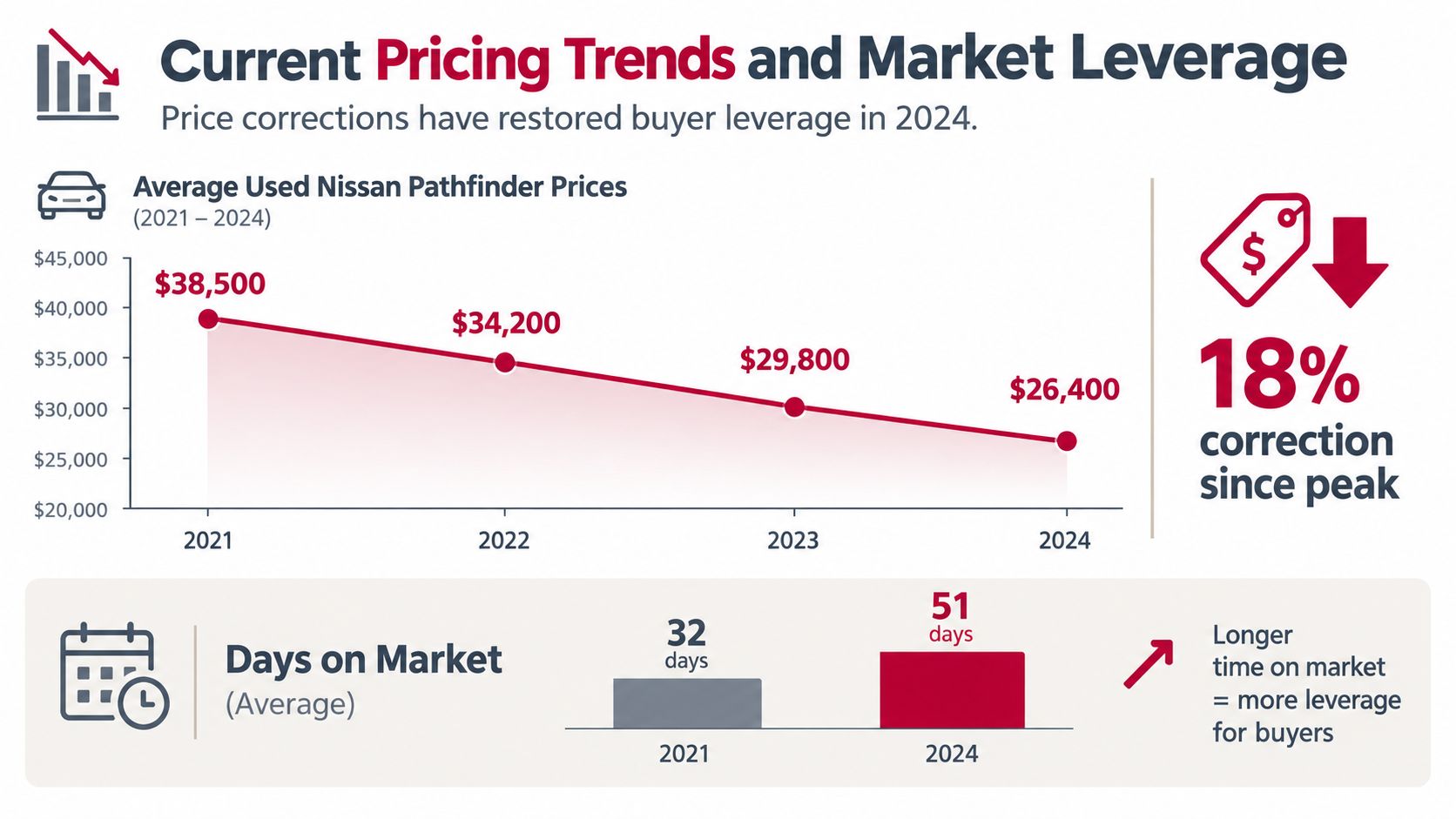
The used Pathfinder market gives buyers a useful negotiating position because prices aren’t moving in only one direction. A current CarGurus used Pathfinder market listing analysis reports a nationwide average used price of $26,452, with the year’s low at $24,662. The same source notes that prices have fallen for the 2023 through 2025 model years, including a 14.86% decline for 2025 models.
That correction changes the way you should shop. Don’t assume a nearly new Pathfinder is automatically worth its asking price only because it has low mileage. A dealer with aged inventory has a reason to respond to a serious buyer, especially when comparable listings are priced lower.
Compare the price gap, not just the model year
A 2026 buying guide places average used pricing at about $27,000 for a 2022 Pathfinder and about $33,000 for a 2025 Pathfinder, a roughly $6,000 difference, according to the CarGurus Pathfinder buying guide. That gap can reflect mileage, equipment, condition, remaining coverage, and depreciation. It doesn’t automatically mean the newer vehicle is the better financial choice.
Ask the dealer to explain what the newer Pathfinder adds for your use. If the answer is mostly lower mileage and a newer registration date, calculate whether the premium fits your budget. A properly inspected 2022 model may preserve the practical strengths you need while leaving money available for taxes, insurance, maintenance, or a larger down payment.
The wider sales history also helps explain why inventory spans so many price tiers. Pathfinder U.S. sales moved from 63,056 in 2007 to 33,555 in 2008, then 18,341 in 2009, before recovering to 42,621 in 2012 and 88,632 in 2013, according to the same buying guide. Those fluctuations contributed to a varied used inventory, from older high-mileage vehicles to newer certified examples.
Categorizing Pathfinder Generations for Buyers
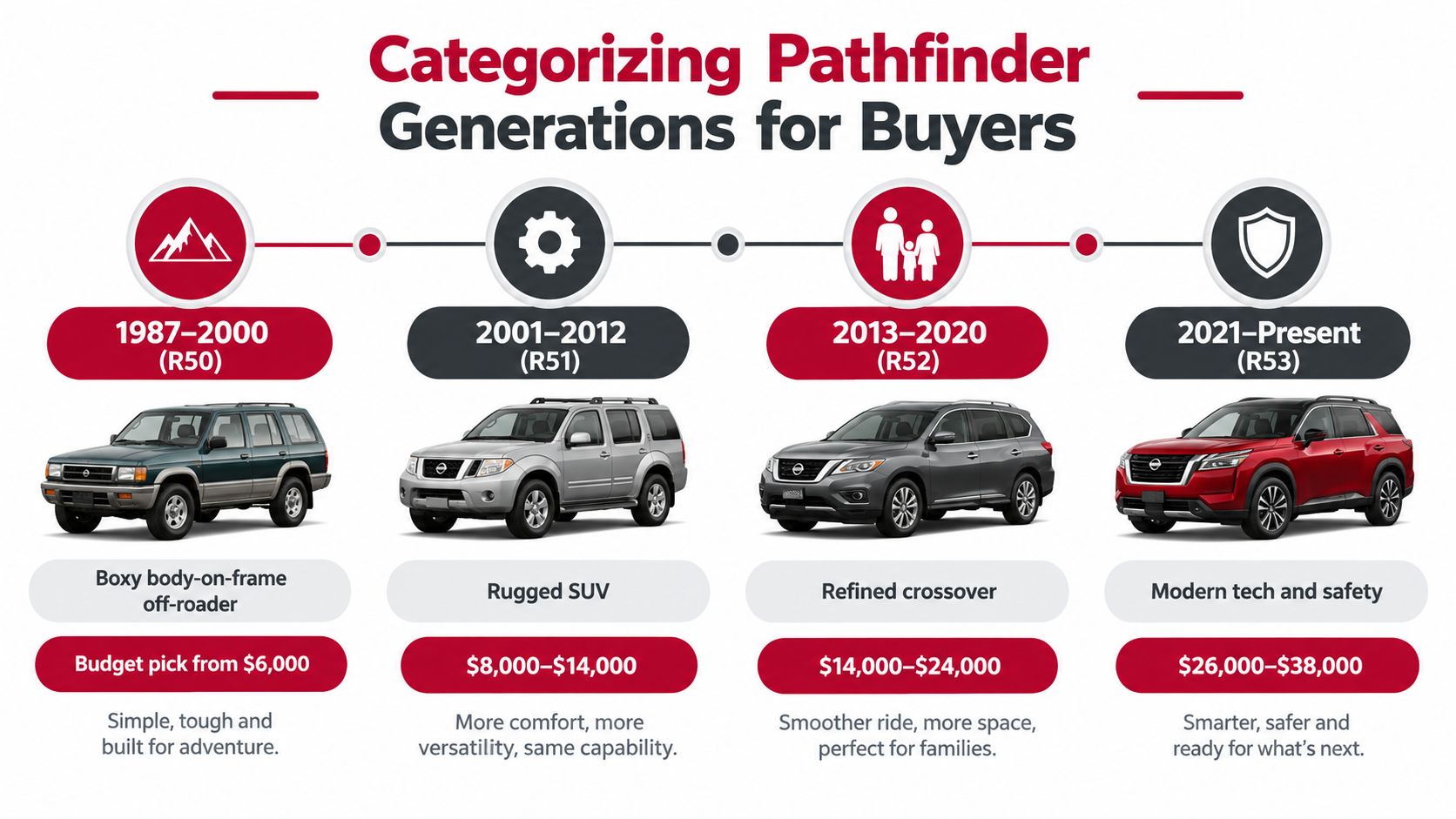
A Pathfinder search becomes easier when you sort inventory into broad mechanical categories rather than browsing every listing in one large pool. The oldest truck-based models offer a different ownership experience from the later crossover generation, and the newest vehicles should be evaluated with towing architecture and electronic equipment in mind.
Truck-based generations
The early Pathfinder is the choice for a buyer who values a boxier body, traditional SUV construction, and a more rugged driving character. These vehicles can be appealing as budget-oriented utility vehicles, but age becomes the central issue. Rust, worn suspension components, neglected fluids, and previous off-road use deserve more attention than the odometer alone.
The next rugged era offers a larger vehicle and a more practical cabin while retaining a traditional SUV identity. It can suit a buyer who wants capability without moving into the newest price tier. Confirm maintenance records carefully, because a low purchase price doesn’t protect you from deferred drivetrain or chassis work.
Crossover-oriented models
The crossover generation is generally the more natural fit for school runs, commuting, and family road trips. It emphasizes a smoother road experience and a less truck-like feel. Buyers who don’t tow frequently may prefer this balance, particularly when a clean example costs meaningfully less than a newer model.
Don’t buy this generation expecting every vehicle to behave like a heavy-duty tow rig. Equipment, drivetrain, condition, and payload still matter, and marketing language shouldn’t replace a factory label or service record.
Modern fifth-generation models
The 2021-present generation is the strongest match for shoppers who want contemporary technology, a more conventional SUV feel, and documented towing capability when the correct package is installed. A newer purchase usually brings a higher price, but it may reduce compromises in cabin design, safety equipment, and daily usability.
Choose the generation that matches your workload. A commuter doesn’t need to pay for heavy-towing hardware, and a trailer owner shouldn’t buy based on cabin photos alone.
Trim Levels and Towing Capacity Realities
The biggest Pathfinder towing misconception is that every V6 model can pull the same trailer. A V6 Pathfinder does not automatically tow 6,000 pounds. The 2022-present Pathfinder uses a 3.5L V6 producing 284 horsepower and 259 lb-ft of torque, paired with a 9-speed automatic transmission. Its maximum rating reaches 6,000 pounds only with the correct tow package, as documented in the 2022 Pathfinder specifications from Kelley Blue Book.
That rating belongs to a properly equipped vehicle, not every Pathfinder on a dealership row. Tow equipment, drivetrain, cooling hardware, axle configuration, and available payload determine the safe combination. Passengers, luggage, a hitch-mounted carrier, and trailer tongue weight all consume payload before the trailer is connected.
Use the factory label as the final authority
Before negotiating, inspect the door-jamb certification label and match the vehicle identification number with the factory equipment record. Confirm the hitch, wiring, cooling provisions, and other tow-specific hardware. A seller’s statement that “all V6 Pathfinders can pull the same weight” is not evidence.
Older late-model Pathfinders may also reach 6,000 pounds when properly equipped, while earlier V8-equipped versions reached 7,000 pounds, according to Nissan’s archived towing guides. Those figures apply to specific configurations. Do not transfer a rating from one model year or trim to another.
| Trim level | Engine and drivetrain | Maximum towing with package |
|---|---|---|
| S | 3.5L V6, FWD standard, AWD optional | Up to 6,000 lb with tow package |
| SV | 3.5L V6, FWD standard, AWD optional | Up to 6,000 lb when properly equipped |
| SL | 3.5L V6, FWD standard, AWD optional | Up to 6,000 lb when properly equipped |
| Platinum | 3.5L V6, FWD standard, AWD optional | Up to 6,000 lb when properly equipped |
| Rock Creek | 3.5L V6, AWD standard, factory tow equipment | Confirm the exact factory rating on the door-jamb label |
Use the table to narrow candidates, then verify the label before signing. If towing drives the purchase, prioritize the installed equipment and documented rating over trim appearance. A lower-priced Pathfinder without the required hardware can cost more to make suitable for the trailer you already own.
Long-Term Reliability and Ownership Costs
A low purchase price can hide expensive mechanical work. The Pathfinder’s ownership cost depends less on its badge than on its generation, drivetrain, mileage, service records, and previous use. RepairPal rates it 3.5 out of 5 and reports average annual repair and maintenance costs of about $517, compared with $494 for midsize SUVs overall and $591 across all vehicles in its dataset, as summarized by CarMax’s Pathfinder ownership research.
Use those figures to set a budget, then inspect the specific SUV. AWD service, worn tires, overdue brakes, neglected fluids, and towing-related wear can quickly consume the savings from a lower asking price. A market correction gives buyers room to negotiate, but it does not make deferred maintenance cheaper.
Inspect the drivetrain history
Request invoices, fluid-service records, and repair documentation. AWD buyers should verify drivetrain fluid intervals and inspect for leaks, vibration, or binding. Buyers comparing recent generations should pay close attention to transmission behavior, cooling-system condition, and evidence of heavy towing or repeated short trips. A clean vehicle history report helps establish ownership history. It does not replace a mechanical inspection or proof of completed maintenance.
Owner feedback is mixed. Edmunds reports praise for the smooth ride, roomy cabin, strong power, and value, alongside complaints about weak storage, uncomfortable seats, and technology or service issues in its Pathfinder owner review coverage.
A separate 2025 reliability summary cited 51 NHTSA complaints and 1 recall, with brake and powertrain concerns appearing most often, according to NHTSA’s recalls and complaints information. Check the specific vehicle for open campaigns, completed repairs, warning lights, shifting problems, and road-test symptoms. Complaint counts describe reported issues, not a verdict on every model year.
Judge the individual Pathfinder. Require documented maintenance, an independent inspection, and an ownership budget that leaves room for repairs.
Standard Used vs Nissan Certified Pre-Owned
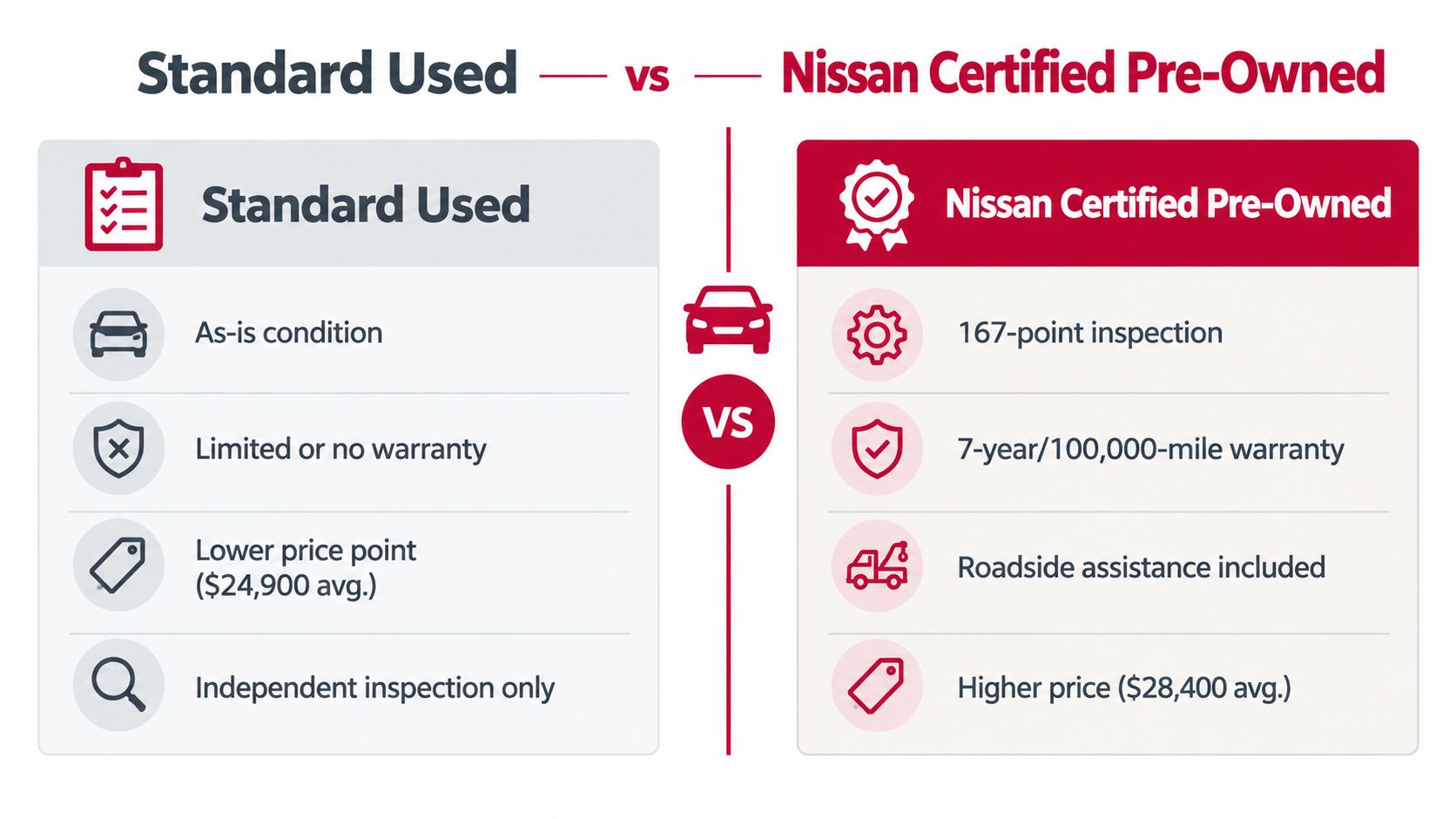
A standard used Pathfinder can be the better financial choice when the vehicle has strong records, passes an independent inspection, and is priced below comparable certified inventory. You control the risk by spending money on inspection before signing, reading the warranty contract carefully, and leaving room in your budget for normal maintenance.
Nissan Certified Pre-Owned inventory makes more sense when you place a high value on factory-backed coverage and a standardized inspection process. It can also be attractive to a buyer who wants a newer Pathfinder but doesn’t want to purchase completely outside the manufacturer-backed channel.
Calculate the premium before agreeing
Don’t pay extra for a CPO badge without identifying what the premium buys. Compare the vehicle’s selling price with similar standard used Pathfinders, then review the warranty exclusions, deductible, transfer terms, roadside provisions, and inspection documentation. A warranty doesn’t cover every wear item or every problem caused by poor maintenance.
A standard used Pathfinder may win when the price difference is substantial and an independent mechanic finds no meaningful concern. CPO may win when the coverage reduces your financial exposure and the monthly payment remains comfortable. In either case, the inspection report should be specific to the vehicle you’re buying.
Ask for the completed certification paperwork, not just a salesperson’s verbal summary. Confirm that the title history is clear, the vehicle identification number matches every document, and recall work has been completed. That diligence matters more than a polished badge on the windshield.
Financing Strategies and Trade-In Valuations
A low payment can hide an expensive deal. Get pre-qualified or approved before visiting the dealership, then use a payment calculator to set a maximum purchase price from the total amount financed. Current price corrections give buyers more room to negotiate, but only if they control the numbers instead of chasing a monthly payment.
Ask for the Pathfinder’s selling price, taxes and fees, trade allowance, down payment, interest rate, loan term, and amount financed as separate figures. Review each line before discussing optional products. A longer term may reduce the payment while increasing total interest, and add-ons can consume the savings created by a lower vehicle price.
Keep the negotiations separate
Get a trade valuation before choosing the Pathfinder. A market reference, such as the trade-in valuation tool available through Heights Nissan, helps establish a starting point. The final offer still depends on the vehicle’s condition, equipment, history, and local demand.
Use this order:
- Choose the vehicle: Confirm the Pathfinder’s generation, equipment, history, and condition.
- Set the selling price: Negotiate the purchase price without including the trade.
- Review the trade value: Compare the allowance with realistic alternatives.
- Approve the financing: Compare the rate, term, amount financed, and optional products.
- Read the final contract: Verify that every agreed figure appears correctly.
Negative equity deserves direct attention. Rolling the balance into a longer loan can leave you owing more than the Pathfinder is worth. Make a larger down payment, choose a less expensive vehicle, or wait until the trade balance is manageable.
Bring your own financing quote and let the dealership try to beat it. Compare the interest rate and total repayment cost, not just the monthly figure. A strong trade value can improve the deal, but a clean purchase price and controlled financing matter more.
The Dealership Inspection and Test Drive Checklist
A used Pathfinder should earn your confidence in person. Listing photos can’t reveal transmission behavior, fluid leaks, uneven tire wear, cold-start noises, or whether the third row works properly. Arrive with enough time to inspect the vehicle before discussing how quickly you can take delivery.
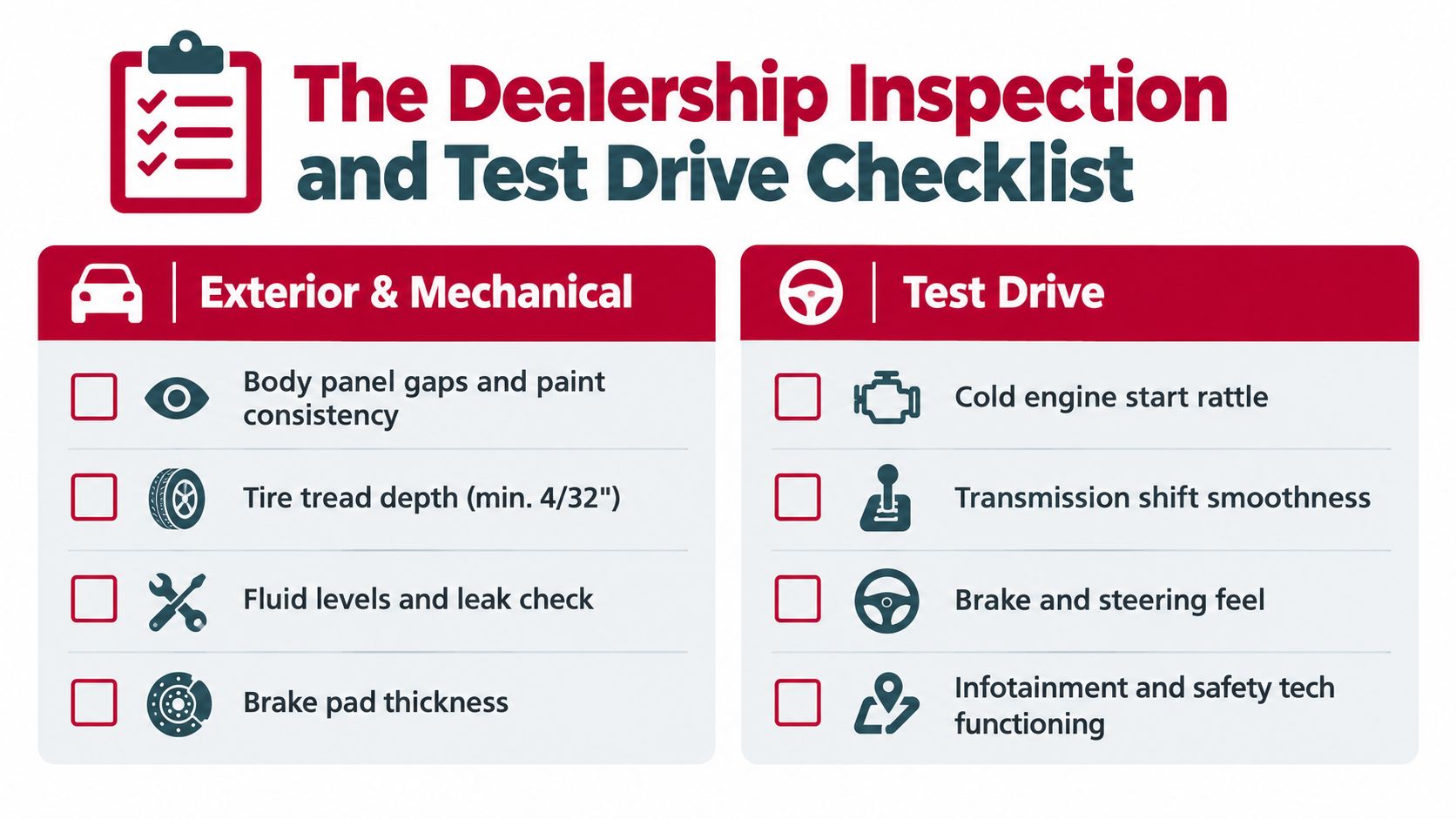
Begin outside and under the hood
Walk around the vehicle in daylight. Look for mismatched paint, inconsistent panel gaps, overspray, cracked lamps, windshield damage, and signs of prior collision repair. Check all doors, the liftgate, the hood, and the fuel door. Open the roof rails, hitch area, and lower bumper sections if the vehicle was advertised for towing.
Then check the mechanical basics:
- Tires: Look for even wear across each tire and confirm that all four tires are appropriate for the drivetrain.
- Fluids: Inspect visible fluid levels and look beneath the vehicle for fresh leaks.
- Brakes: Ask to see the pads and rotors if wear is unclear.
- Service records: Match documented work to the vehicle’s mileage and equipment.
- Recall status: Ask the dealer to verify whether required campaigns are complete.
Test the Pathfinder as a family would use it
Start the engine cold if possible. Listen for rattles, rough running, warning lights, or delayed engagement. Drive through city streets, a faster road, turns, hills, and a parking maneuver. The 9-speed automatic should shift without harsh engagement, repeated hunting, or unexplained hesitation.
Test the brakes in a controlled area and check whether the steering tracks straight. If the Pathfinder is AWD, ask how the system engages and test it only in a safe, appropriate location. Cycle the climate controls, infotainment, cameras, driver-assistance features, power seats, sliding or folding second-row functions, and third-row access.
Bring child seats or cargo if those items are part of your daily routine. A vehicle can look roomy on a showroom floor and still fail your actual loading test.
If the dealer won’t allow an independent inspection, find another Pathfinder. A good vehicle doesn’t need secrecy.
Final Decision Matrix and Quick Lookup Guide
Your best Pathfinder choice depends on the job you need it to perform. The following matrix is deliberately practical. It favors verified condition and equipment over showroom appeal.
| Buyer profile | Strongest target | Purchase approach | Main warning |
|---|---|---|---|
| Heavy tower | A properly equipped 2022-present Pathfinder or a verified late-model tow configuration | Standard used or CPO, with factory equipment confirmed | Never assume the V6 alone provides the maximum rating |
| Family needing modern technology | A clean fifth-generation Pathfinder with the features you use daily | CPO can make sense when coverage justifies the premium | Compare the price gap with similar standard used vehicles |
| Budget-conscious commuter | A well-maintained crossover-generation Pathfinder | Standard used with an independent inspection | Avoid saving money by accepting poor records or drivetrain neglect |
| Buyer wanting older rugged character | An early truck-based Pathfinder with documented structural and mechanical condition | Standard used only after a careful inspection | Age-related wear can outweigh the low purchase price |
| Risk-sensitive household | The cleanest, best-documented vehicle within budget | CPO if the coverage terms fit your needs | Don’t confuse certification with a substitute for test-driving |
For towing, verify the factory certification label and remaining payload after passengers and cargo. For financing, compare the total amount financed rather than chasing a low monthly payment. For reliability, prioritize records, inspection results, and recall completion over trim badges.
The strongest deal is usually not the cheapest Pathfinder on the internet. It’s the vehicle that meets your needs without forcing you to pay for unneeded capability, accept undocumented maintenance, or stretch your financing beyond a comfortable budget.
Heights Nissan offers used and Nissan Certified Pre-Owned inventory, online financing tools, trade-in valuation support, and Nissan-trained service resources for shoppers comparing a Pathfinder for sale used. Review the available vehicles and arrange a professional inspection or test drive through Heights Nissan before you commit to a specific listing.
0 comment(s) so far on Pathfinder for Sale Used: 2026 Buyer Guide