
Used Car Nissan Buying Guide: What to Know First
You’re standing on a lot in Queens, looking at two used Nissans with the same sticker. One is a Rogue that looks like the sensible family play, the other is a Sentra that fits your payment better. That’s the right moment to slow down, because used Nissan isn’t one answer. It’s a lineup of very different cars, trucks, and EVs, and the right one depends on the exact model, year, powertrain, and how it was used before you saw it.
Table of Contents
- Why a Used Nissan Is Really a Model-by-Model Decision
- The 2026 Used Nissan Market at a Glance
- Best Used Nissan Models for Common Buyer Profiles
- Inspection Checklist Before You Sign Anything
- Certified Pre-Owned Nissan Versus Private-Party Purchase
- Financing a Used Nissan Without Overpaying
- Reliability Myths and Battery Gotchas Buyers Overlook
- Putting Your Used Nissan Plan Together
Why a Used Nissan Is Really a Model-by-Model Decision
A lot of first-time buyers walk in thinking the badge tells the whole story. It doesn’t. A Nissan GT-R that holds value far better than a basic commuter sedan, a Nissan Z that also keeps resale stronger than the average Nissan, and a Nissan Sentra that sits much lower in the pack all wear the same nameplate, but they do not carry the same ownership risk or resale behavior.
What decides whether it’s a smart buy
The car in front of you comes down to four separate calls. Model-year generation matters because Nissan changed different nameplates at different times. Drivetrain type matters because a truck with a traditional automatic and a sedan with a CVT do not have the same risk profile. Prior service pattern matters because documented maintenance shows whether the last owner kept up with the car or ignored it. Original use case matters too, because a fleet car and a personal commuter usually age differently.
That is why generic advice about “buying a used Nissan” falls apart fast. A Frontier with the right powertrain can be a solid truck buy, while a CVT-equipped sedan demands a much tighter inspection. A LEAF adds battery health to the conversation, which gas buyers do not face. The badge gets you in the right section of the lot, but it does not finish the decision.
Practical rule: shop the exact year and powertrain, not the logo.
Treat a used Nissan like a lineup of nameplates, not one brand. Some models are value plays. Some are long-haul commuter cars. Some only make sense when the service records are clean and the transmission history checks out. That is the mindset that keeps a buyer from paying too much for a nice-looking car with the wrong backstory.
The 2026 Used Nissan Market at a Glance
The used Nissan market in 2026 favors buyers who shop with discipline. CarGurus’ 2026 price index puts the average used Nissan at $20,148, which is 30.51% below the overall used-car market average in its dataset, and Nissan prices were down 0.23% over the previous 30 days, compared with 0.46% for the broader market (CarGurus Nissan price index). That is a bargaining market, plain and simple.
Where the inventory pressure is
Nissan supply is heaviest in the nameplates that sold in the largest numbers. Rogue and Altima show up often, so buyers can compare condition, mileage, and service history across more examples. That usually gives you room to press on price. Frontier, Titan, and Murano are thinner on the ground, so a clean example can hold closer to asking price because there are fewer substitutes on the lot.
Nissan does not hold value evenly across the lineup. As noted earlier, resale can swing sharply from one nameplate to another, and the strongest retention sits with models that pull demand from enthusiasts or unusually loyal owners. For shoppers, that means Nissan often gives you more room than Toyota or Honda, but only if you stay selective and ignore the badge-first mindset.
What to expect before you negotiate
The cleanest deals go to buyers who already know which Nissan they want. A compact commuter pulls from a different inventory pool than a truck or an EV. A family SUV buyer is really competing against other Rogue shoppers, so trim, condition, and history matter more than brand loyalty.
| Model | 2018-2019 Avg Price | 2021-2022 Avg Price | 5-Year Residual |
|---|---|---|---|
| Sentra | Qualitatively lower than midsize SUVs | Qualitatively higher than older compacts | 66.7% on the Sentra after 5 years |
| Rogue | Qualitatively higher than a compact sedan | Qualitatively stronger in recent redesign years | Resale varies by generation and trim |
| LEAF | Qualitatively higher when battery state of health is strong | Qualitatively sensitive to battery condition | Battery health matters more than body style |
| Frontier | Qualitatively firmer in clean, well-kept examples | Qualitatively supported by stronger demand in newer years | Resale depends heavily on powertrain and mileage |
That is the simple read. Nissan is usually a buyer’s market, but only if you stop treating every used example as interchangeable. A good year and a good powertrain can make one model a sharp deal. The wrong one can turn a low sticker into an expensive lesson.
Best Used Nissan Models for Common Buyer Profiles
A smart used Nissan pickup starts with the buyer profile, not the showroom mood. If your budget is tight, your commute is long, or you want to skip CVT drama entirely, the shortlist changes fast. The right trim and year can make the difference between a car you like and a car you’re stuck explaining to your mechanic.
Budget, family, commuter, and EV picks
For a budget buyer around $10,000, I’d look at a 2018+ Sentra S or a 2017 Versa SV if the miles are reasonable and the service history is there. The point isn’t luxury, it’s getting into a post-revision Nissan that hasn’t been neglected. During inspection, verify the CVT service history and make sure the transmission isn’t shuddering or whining under steady acceleration.
For a family buyer, the better target is a 2019-2022 Rogue SV or SL with the four-cylinder setup. Avoid the older generation that carries the oil-consumption reputation, and pay attention to the 2021 refresh if infotainment matters in daily life. If you’re loading up kids and cargo, check that the cabin electronics, rear climate behavior, and maintenance records match the mileage.
For a daily commuter who wants to sidestep CVT risk, the clean answer is a 2018+ Frontier. The traditional automatic keeps you out of the CVT conversation entirely, and that alone is worth money if you plan to keep the truck a while. Verify frame condition, tire wear, and routine service consistency.
For a first-time EV buyer, the 2018-2020 LEAF with the 40 kWh pack is the sweet spot if the battery still has healthy state of charge and the miles stay sensible. Battery state of health matters more than paint or wheel condition. Check the bars, request battery documentation, and don’t guess.
Practical rule: a clean service record matters more than a shiny exterior on every used Nissan.
The one thing I’d verify first on each
- Sentra or Versa: CVT smoothness and evidence of regular fluid service.
- Rogue: model-year history and signs the engine hasn’t been starved of maintenance.
- Frontier: drivetrain condition, because this is the buy for people who want a straightforward truck.
- LEAF: battery state of health and warranty eligibility, because the pack is the car’s core value.
If you’re shopping in person, use the inspection checklist and the listing photos together. A good car tells a consistent story across the body, the service records, and the way it drives.
Inspection Checklist Before You Sign Anything
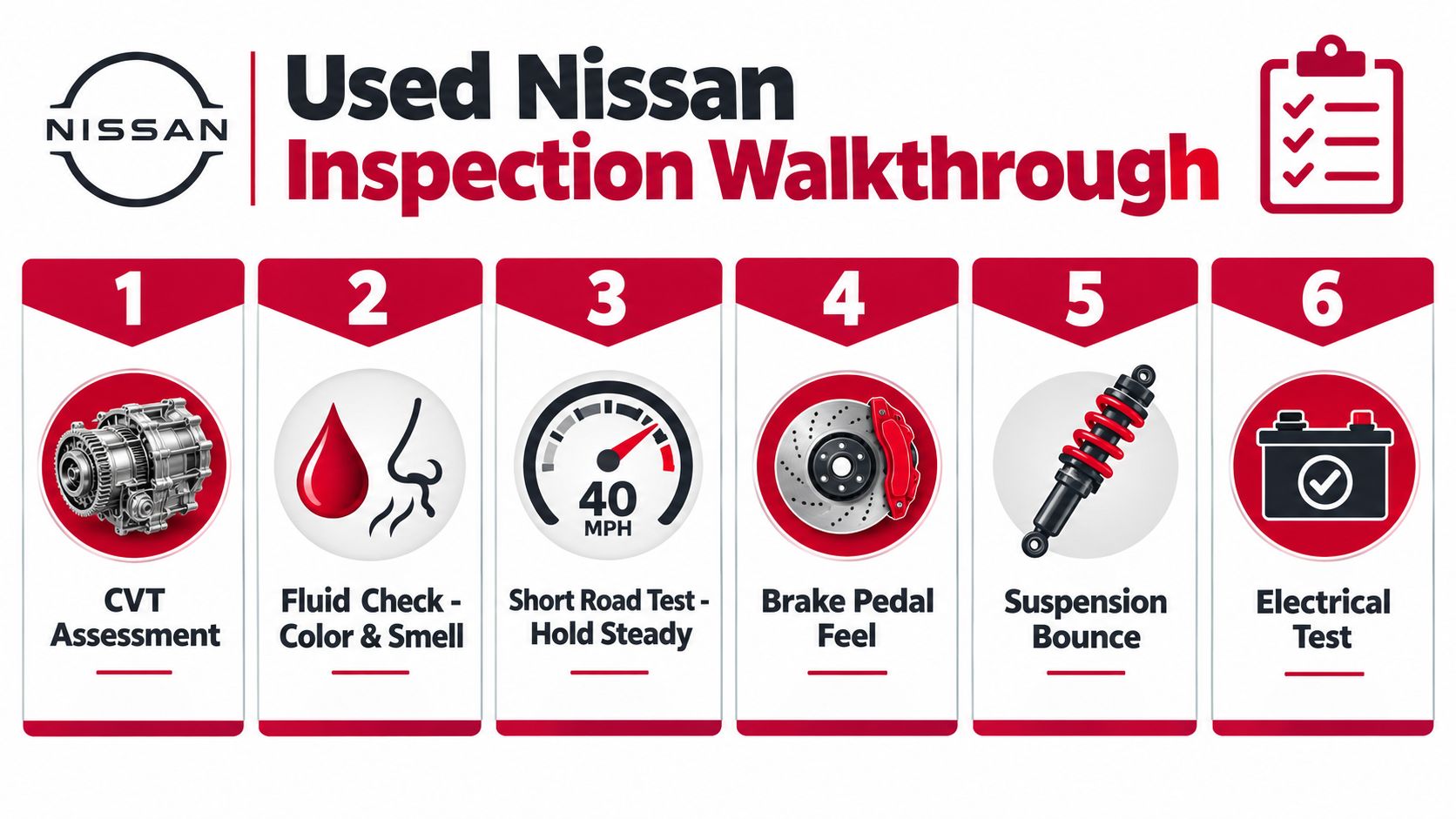
The cheapest mistake you can make on a used Nissan is buying on hope. The CVT is where a lot of shoppers get burned, so start there and stay disciplined. Independent inspection services for Nissan vehicles report over 100 check points, including OBD fault-code reading, paint-thickness measurement, and a dedicated CVT assessment, which is exactly why a thorough inspection is worth paying for (Nissan inspection checklist).
Start with the transmission, then verify the paper trail
Look at the fluid first. If it’s dark, smells burnt, or looks neglected, that car moves down the list immediately. On the road test, hold steady throttle and listen for whine, hesitation, or judder. A healthy Nissan CVT should feel consistent, not nervous.
Then pull an OBD-II scan and look for stored transmission-related fault history. You want a shop to check live data, readiness monitors, and any code history tied to CVT control issues. If the seller won’t allow that, walk.
A seller who fights an inspection is telling you more than the ad ever could.
Check bodywork, tires, brakes, and cold-start behavior
Use a paint-depth gauge across every panel if you can. Uneven readings tell you where the car may have been repaired after an accident. That’s not always a deal-breaker, but it changes the price and it changes the risk.
Tire wear should be even from side to side. If it isn’t, something in the suspension, alignment, or driving history is off. Brake rotors should have a clean surface without deep lips or obvious vibration on the test drive. Cold-start the car, listen for rough idle, and watch for warning lights that stay on longer than they should.
Don’t skip the service record
Stamped maintenance records matter, especially on CVT cars. A documented service history around fluid changes tells you the previous owner respected the transmission’s needs. If the car already had a warranty CVT replacement, ask for the paperwork and verify the repair details rather than taking someone’s word for it.
I’d budget $150 to $250 for an independent pre-purchase inspection from a shop that knows Nissan CVTs. That’s cheap insurance against a repair bill you didn’t plan for.
Certified Pre-Owned Nissan Versus Private-Party Purchase
A Nissan CPO deal fits buyers who want fewer surprises and are willing to pay for them. The used Nissans that make the best CPO candidates are the newer, lower-mileage ones with cleaner histories and fewer reasons to doubt the paperwork. You are buying a dealer-checked car, not just a cleaned-up trade-in.
What the CPO premium actually buys you
The warranty package matters. A CPO Nissan keeps the remainder of the original new-car powertrain warranty and adds a 7-year/100,000-mile limited powertrain extension from the original in-service date. Nissan CPO also includes a CARFAX report, roadside assistance, rental-car coverage during warranty repairs, and a $50 deductible per visit.
Private-party shopping usually cuts the asking price by 8% to 15%, and that lower price comes with real tradeoffs. You get no warranty, no roadside help, and no dealer certification to stand behind the car. That can work if you know how to judge condition, can pay for your own inspection, and want the lowest entry cost. For a first-time buyer, it is a riskier path.
| Factor | Nissan CPO | Private-Party Sale |
|---|---|---|
| Eligibility | Less than six years old, fewer than 80,000 miles, clean title, passes 167-point inspection | No formal eligibility gate |
| Inspection | Multi-point dealer certification | Usually none unless you pay for one |
| Warranty | Powertrain coverage plus extension from in-service date | No warranty attached |
| Roadside help | Included | Not included |
| CARFAX | Included | Not guaranteed |
| Price | Higher than private-party | Usually lower, often by 8% to 15% |
Use the badge only after you compare the car itself. A well-kept private-party Nissan with clean records can beat a weak CPO unit on value, especially if you already know the model-year quirks and are prepared to inspect the car properly. A CPO car is the cleaner, safer buy for buyers who want less hassle. A private-party car makes more sense when price matters more and you are willing to do the legwork.
Financing a Used Nissan Without Overpaying
The finance office can erase a good deal if you let it. Start with a credit union pre-qualification before you ever step on a lot, because that gives you a real rate anchor instead of a dealer guess. Then get a soft-pull pre-approval so the dealership has to compete with an actual number, not a vague promise.
Use the calculator like a buyer, not a dreamer
The monthly payment is only part of the cost. You need to look at the total of payments and ask yourself whether the term fits the car’s age and mileage. On a $15,000 used car, a 72-month term can make the payment look easier while stretching the total cost well beyond the sticker.
That’s also where loan-to-value matters. If you’re financing more than 110% of the car’s value on a used Nissan, gap insurance is a smart move. If the car is totaled before you’ve built equity, you don’t want to be left paying on a dead asset.
Put your trade-in to work
Trade-in equity is one of the most underused tools in the process. Get a hard-floor number from KBB Instant Cash Offer or CarMax before you negotiate the purchase price, because a strong trade can lower your real out-of-pocket more than a tiny discount on the car itself. That’s especially true if you’re replacing an older car with maintenance needs of its own.
When you shop loan offers, keep the applications inside a 14-day window so multiple inquiries are treated as one hard pull. If the dealer markup is too wide, refinance around month six once the loan has settled and you’ve had time to compare offers. If you’re local and want an in-person option while you compare quotes, Heights Nissan offers financing help, trade-in valuations, and pre-qualification tools in one place.
Reliability Myths and Battery Gotchas Buyers Overlook
A used Nissan is a model-by-model decision. The badge alone does not tell you much. Some years hold up well, while others carry CVT trouble, complaint spikes, or resale weakness that still shows up on the lot. That is why a shopper should read each nameplate on its own terms, not trust a blanket verdict.
The brand’s overall used-car reliability sits in the middle of the pack, and that is exactly how I would describe it to a first-time buyer, decent in the right years, risky in the wrong ones (CarWhere Nissan reliability overview). The better late-2010s Altima, Sentra, and Rogue trims are the kinds of buys I would put on a short list. They tend to be easier to live with than the problem years that still drag down Nissan’s reputation.
Do not confuse that with a clean bill of health. Federal complaint data still shows that Nissan’s well-known models all have at least one flagged year, so you need to check the exact year and drivetrain before you get attached. Complaint totals are useful as a warning light, but they do not replace a proper model-year check.
The LEAF battery story needs its own lens
The Nissan LEAF is a battery car first and a Nissan second. The pack is air-cooled, so heat and climate hit usable range harder than they do in many liquid-cooled EVs. Voltchek’s battery-health tracking shows useful real-world degradation patterns, but independent LEAF battery studies have also shown meaningful loss at similar mileage, so do not assume every pack ages gently (Nissan LEAF battery health data).
If you are shopping a LEAF, check the dashboard SOC bars and ask for a battery-health report through LeafSpy or an OBD-II scan. I would be strict with early cars, especially a 2011-2015 LEAF that shows heavy bar loss or comes without battery-health paperwork. That is not being picky. That is protecting range, resale, and your budget.
One more rule. Treat the LEAF like a battery purchase, not just a used hatchback. If the pack is weak, the car is already expensive, even if the sticker looks cheap.
Putting Your Used Nissan Plan Together
Start with your role, not the logo. If you’re a commuter, a family buyer, a budget shopper, or a first-time EV buyer, that answer points you toward a very different Nissan shortlist. Then apply the gate. Any candidate older than six years or above 80,000 miles needs the full CVT or battery-health check, while newer CPO-eligible cars can lean more on the manufacturer’s inspection.
Pre-qualify for financing before you go, run a trade-in number through KBB Instant Cash Offer, and compare the dealer rate against your credit-union quote. That sequence keeps the finance office honest and keeps you from shopping by monthly payment alone.
Book the inspection, pull the CARFAX, and verify CPO eligibility before you put money down. If you do those three things and stay model-specific, you’ll shop a used Nissan like a serious buyer instead of a hopeful one.
If you want a local Nissan team that handles used inventory, financing, and service under one roof, visit Heights Nissan. They can help you compare used and Certified Pre-Owned options, check model-year fit, and line up the inspection and financing steps before you commit.
0 comment(s) so far on Used Car Nissan Buying Guide: What to Know First